How to Move Your Pet Abroad Without Surprises
Moving abroad with pets requires more than booking a flight and purchasing an airline-approved carrier. Your relocation date may be set, your visa application may be underway, and your belongings may already be sorted into keep, sell, and store piles. But what about the family member who cannot simply board a plane with a passport and a carry-on?
Learning how to move your pet abroad means understanding international pet travel requirements, veterinary documentation, airline policies, relocation costs, and your destination country's import regulations.
For many Americans moving overseas, relocating a pet is one of the most emotional and complicated parts of the process. It can also be one of the least flexible. A missing vaccination record, an improperly completed health certificate, or a flight booked before the required waiting period ends can delay your move or prevent your pet from entering the country.
The good news is that international pet relocation is manageable with careful planning. The key is to start early, understand the requirements specific to your destination, and build enough flexibility into your moving timeline to handle unexpected complications.
Start With Your Destination's Pet Entry Requirements
One of the biggest mistakes people make when moving overseas with pets is assuming that international pet travel requirements are the same everywhere.
They are not.
Every country establishes its own animal import regulations, and those rules may differ depending on your pet's species, age, vaccination history, and country of departure.
Some destinations require relatively straightforward documentation. Others impose additional testing, import permits, parasite treatments, or quarantine requirements.
Common requirements for moving dogs and cats internationally include:
An ISO-compatible microchip for identification.
A valid rabies vaccination.
An official veterinary health certificate.
Additional vaccinations or parasite treatments.
A rabies antibody titer test, when required.
An import permit or advance arrival notification.
Government endorsement of veterinary documents.
Not every country requires all these steps.
For Americans relocating overseas, the best starting point is the USDA Animal and Plant Health Inspection Service (APHIS) Pet Travel website. It provides destination-specific guidance for traveling from the United States with pets.
You should also verify requirements directly with the destination country's official veterinary or agricultural authority.
Important: Airline approval does not guarantee permission to enter another country. Your pet must meet both the airline's transportation requirements and the destination's animal import regulations. Transit countries may impose additional requirements depending on the route and whether your pet formally enters the country.
Build Your International Pet Relocation Timeline Early
International pet relocation is not something you should leave until the final few weeks before departure.
For uncomplicated destinations, several weeks may be sufficient once vaccinations and identification are already compliant. Other destinations require months of preparation, particularly when rabies antibody testing and mandatory waiting periods are involved.
A practical approach is to begin researching your destination's requirements at least three to six months before moving, and earlier for countries with complex import procedures.
Your timeline should account for microchipping, vaccinations, blood tests, laboratory results, import permits, veterinary appointments, government endorsements, and airline reservations.
Why timing matters
Consider the European Union.
For a dog or cat entering the EU from the United States under the standard non-commercial pet travel rules, an ISO-compliant microchip must generally be implanted or read before the rabies vaccination used for travel. After a primary rabies vaccination, a minimum 21-day waiting period normally applies before entry.
Pets arriving directly from the United States generally do not need a rabies antibody titer test for EU entry because the United States is on the EU's list of countries with favorable rabies status. However, travel history and routing can affect requirements.
Other countries have different timelines. Australia, for example, has a more complex import process involving eligibility checks, veterinary preparations, and quarantine arrangements.
The lesson is simple: Work backward from your departure date rather than assuming your pet can travel whenever you are ready.
How to Move Your Pet Abroad: Health Certificates and Paperwork
Getting your pet's documentation right is one of the most important steps in the relocation process.
If you are leaving from the United States, begin with a USDA-accredited veterinarian who has experience preparing international health certificates. Not every licensed veterinarian holds USDA accreditation.
Your veterinarian will help determine which examinations, vaccinations, laboratory tests, and certificates are required.
For destinations requiring USDA endorsement, your veterinarian can submit the documentation through the Veterinary Export Health Certification System (VEHCS). Some countries accept digitally endorsed certificates, while others require printed originals.
According to USDA APHIS, incorrect or incomplete paperwork can delay endorsement. Some health certificates also have narrow validity periods, making appointment timing especially important.
Before departure, double-check your pet's microchip number, vaccination dates, vaccine information, owner details, and required signatures.
Keep original documents accessible during travel, along with digital backup copies. Digital backups are useful, but they do not replace original paperwork when authorities require it.
Pet Travel Requirements for Popular Destinations
Although every destination has its own regulations, understanding a few common examples can help you recognize why researching the rules early matters.
Moving pets to Spain and other EU countries
For Americans relocating to Spain, France, Portugal, Italy, or other EU destinations, dogs, cats, and ferrets generally need compliant identification, valid rabies vaccination, and an EU animal health certificate.
For standard non-commercial travel from outside the EU, the certificate generally must be issued within 10 days before the pet arrives in the EU. Certain destinations also require tapeworm treatment for dogs.
Once established in Europe, an EU pet passport issued by an authorized veterinarian may simplify qualifying future travel within the EU.
The European Commission's pet travel guidance also explains the standard five-pet limit and the special conditions that apply when a pet travels separately from its owner
When I moved to Spain with two dogs, the experience reinforced how important it is to organize pet relocation alongside the rest of the international move. Veterinary appointments, airline arrangements, and documentation all need to fit within the same timeline.
Moving pets to the United Kingdom
Great Britain has its own pet entry rules, separate from the EU.
Dogs, cats, and ferrets generally need identification, rabies vaccination, and appropriate travel documentation. Dogs also usually require veterinary-administered tapeworm treatment between 24 and 120 hours before arrival, subject to specific exemptions.
Approved travel routes and carriers are another consideration, particularly for travelers arriving by air.
Review the UK government's official pet entry requirements before purchasing tickets.
Moving pets to Australia and other destinations
Australia has more restrictive animal biosecurity procedures than many European destinations. Depending on the animal's eligibility and preparation, importing a dog or cat can involve an import permit, extensive veterinary requirements, and mandatory post-entry quarantine.
Some eligible animals may qualify for a minimum 10-day quarantine period, while others require longer. Do not assume the shortest period will apply.
Start with the Australian Department of Agriculture's official import guidance.
For destinations in Latin America, Asia, or elsewhere, check the specific country's current regulations rather than relying on general regional advice. Entry requirements can vary considerably between neighboring countries.
Understand Breed, Species, and Age Restrictions
Not every pet can travel to every destination, even when its vaccinations are current.
Certain countries restrict particular dog breeds. Airlines may also limit transportation of brachycephalic, or short-nosed, breeds because their anatomy can increase respiratory risks during travel.
Puppies and kittens may be too young to meet rabies vaccination and waiting-period requirements. Exotic pets, birds, and reptiles can require additional permits or wildlife-related documentation.
Older animals or pets with serious medical conditions deserve particular consideration. Discuss the proposed route, journey duration, and travel conditions with your veterinarian before making arrangements.
The right travel plan should reflect your individual animal's health, not simply the cheapest available flight.
Choose the Safest Realistic Flight Plan
Whenever practical, a nonstop flight is often preferable because it reduces transfers, handling, and opportunities for disruption.
Pets generally travel in one of three ways: in the passenger cabin, as checked pets in the aircraft hold where permitted, or through an airline's cargo service.
Small pets may qualify for cabin travel when they fit comfortably inside an approved carrier under the seat. Larger pets often require transportation in the aircraft hold, subject to airline restrictions.
Before booking, confirm the carrier's pet policy for your exact flight, including connecting flights operated by partner airlines.
Ask about temperature restrictions, seasonal embargoes, crate specifications, check-in procedures, and pet reservation limits.
Choose a correctly sized carrier or crate that allows your animal to stand naturally, turn around, and lie down comfortably. Introduce it gradually, ideally weeks before departure.
Avoid sedating your pet unless your veterinarian specifically determines that a medication is appropriate. Sedation can introduce risks, and airlines may restrict its use.
How Much Does It Cost to Move a Pet Abroad?
International pet relocation costs vary considerably. The biggest factors are your destination, animal size, airline, veterinary requirements, travel season, and whether you use a professional relocation company.
The following are illustrative U.S. dollar budgeting allowances, not verified market averages or guaranteed quotes. They are intended to help you prepare an initial budget.
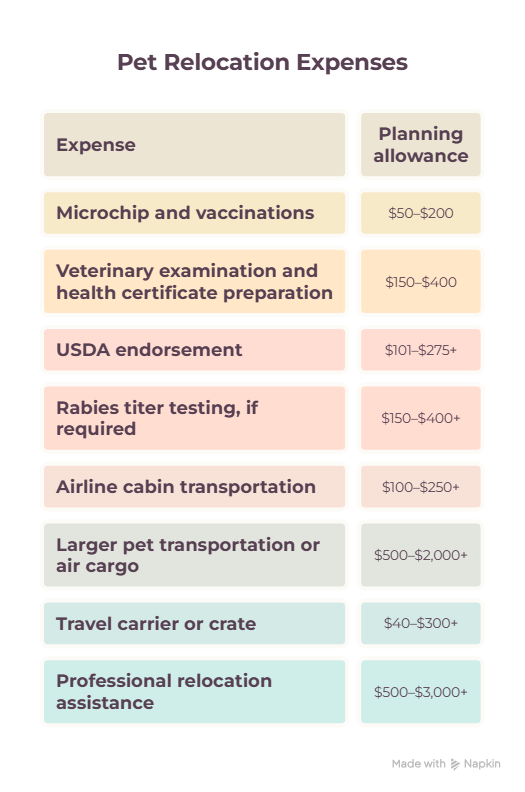
These expenses are not necessarily cumulative. Some pets already have valid vaccinations and microchips, and professional relocation quotes may include transportation or paperwork services.
One fee that can be verified directly is USDA endorsement. As of October 2026, USDA lists $101 for an eligible certificate requiring no laboratory tests, $160 for a single pet with one or two required tests, and higher amounts for additional testing. Veterinary preparation fees are separate. See the USDA endorsement fee schedule.
Cargo transportation, quarantine, import taxes or charges, airport handling, and additional veterinary appointments can substantially increase the total.
For budgeting purposes, a relatively straightforward international move with a small cabin-eligible pet may cost several hundred dollars, while complex cargo relocations can reach several thousand dollars.
Request itemized written estimates before committing to any pet relocation service.
Plan for Your Arrival, Not Just Your Departure
Your pet's journey does not end when the aircraft lands.
Confirm whether you must report to an animal inspection office, complete customs clearance, or arrange collection through a cargo facility.
Secure pet-friendly accommodation before leaving the United States. if possible. Check restrictions on breed, weight, number of animals, and whether pets may remain unattended.
Once you arrive, research local registration requirements, leash regulations, veterinary services, and any additional vaccination obligations.
Pack an arrival kit with food, water supplies, a leash, waste bags, necessary medications, veterinary documents, and a familiar item from home. Check import restrictions before packing pet food or medication.
Keep the first several days relatively predictable. Your pet may need time to adjust to unfamiliar sounds, surroundings, temperatures, and routines.
Don't Forget the Rules for Returning to the United States
One commonly overlooked issue is what happens if you eventually return to the United States with your pet.
The Centers for Disease Control and Prevention requires dogs entering or returning to the United States to meet specific import conditions.
Under current rules, dogs generally must be at least six months old, appear healthy, have a readable microchip, and be accompanied by a CDC Dog Import Form receipt. Additional documentation and procedures apply when a dog has been in a country classified as high-risk for dog rabies during the preceding six months.
For certain U.S.-vaccinated dogs returning from high-risk countries, a specific USDA-endorsed rabies certification must be completed before the dog leaves the United States. It cannot be obtained retroactively.
Before moving, consult the CDC's official dog import requirements, particularly if you expect to return or travel between countries.
Planning for a possible return trip now may prevent complications later.
A Final Pre-Flight Checklist
During the final days before departure, review your arrangements carefully.
Confirm your pet's airline reservation, check-in location, and carrier dimensions.
Verify vaccination records, health certificate validity, and government endorsements.
Check whether parasite treatments or arrival notifications must be completed within specific time windows.
Keep original documentation accessible throughout the journey.
Confirm transportation and pet-friendly accommodation at your destination.
Have an emergency plan for cancellations, delays, or missed connections.
Most importantly, prioritize your pet's welfare over your preferred moving date. Sometimes that means paying more for a direct flight, postponing travel during extreme temperatures, or allowing extra time to meet veterinary requirements.
Make Pet Relocation Part of Your Overall Moving Plan
Moving pets internationally is just one piece of a much larger relocation process. Between visas, housing, healthcare, financial planning, and documentation, it is easy for important deadlines to overlap.
The Moving Abroad Planner from Global Footprints Abroad helps organize your international move with relocation checklists, budgeting tools, document planning, and a moving timeline. Use it to keep your overall relocation organized while maintaining a separate checklist for your pet's destination-specific requirements.
Final Thoughts: Moving Abroad With Your Pet
Learning how to move your pet abroad does not have to be overwhelming, but it does require preparation and attention to detail.
Start with official government requirements, work with an experienced veterinarian, understand your airline's policies, and budget for expenses that may not be obvious at first.
Every pet and every destination is different. What works for a small dog flying to Spain may be entirely unsuitable for a larger dog traveling to Australia.
With realistic expectations, organized documentation, and enough time to prepare, you can make informed decisions that support your pet's safety and comfort.
After all, moving abroad is about building a new life, and for many of us, that new life would not be complete without our pets.
Official Resources for International Pet Travel
These government resources are useful starting points for researching your destination's current requirements.
USDA APHIS International Pet Travel: Country-specific requirements, veterinary certificates, and endorsement procedures for pets departing the United States.
European Commission Pet Travel: Rules for dogs, cats, and ferrets entering or traveling within the European Union.
UK Government Pet Entry Requirements: Documentation, vaccination, tapeworm treatment, and approved travel arrangements for Great Britain.
Australian Government Pet Import Information: Eligibility, import permits, veterinary preparations, and quarantine.
CDC Dog Import Requirements: Rules for dogs entering or returning to the United States.
Disclaimer: International animal import requirements, airline policies, and government fees can change. Verify current requirements with the appropriate authorities and your veterinarian before making travel arrangements.