International Travel Planning Checklist
Miss one passport rule or entry form, and a dream trip can turn into an airport headache fast. A solid international travel planning checklist keeps the exciting parts of travel front and center while protecting you from the avoidable problems - expired documents, surprise fees, and last-minute scrambling.
For US travelers, planning a trip abroad usually involves more moving parts than domestic travel. You may be balancing visa rules, health requirements, currency exchange, phone access, transportation on arrival, and cultural expectations that are easy to overlook when you are still in research mode. The good news is that once you organize the process in the right order, international travel feels much more manageable.
What an international travel planning checklist should cover
A useful international travel planning checklist is not just a packing list. It should help you make decisions before you book, protect your budget, and prepare you for how the trip will actually feel on the ground. That matters whether you are heading out for a 10-day vacation, working remotely for a month, or testing a destination before a possible move abroad.
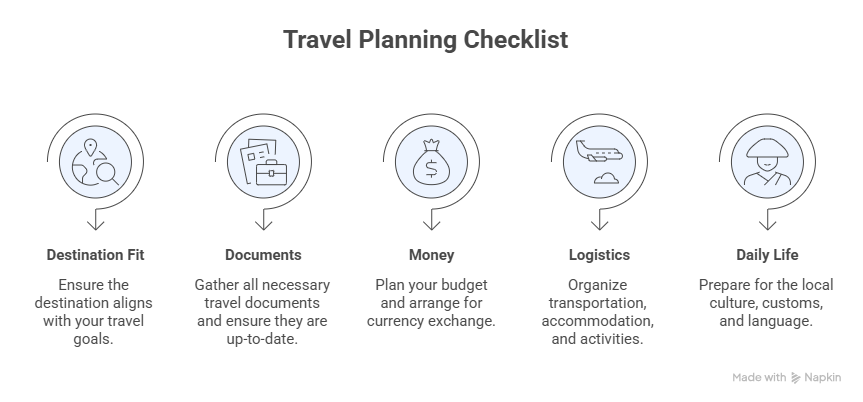
The smartest checklists cover five areas: destination fit, documents, money, logistics, and daily life. If one of those is missing, travelers often end up prepared for the flight but not for the experience.
Start with destination fit, not flight deals
Cheap airfare can be persuasive, but a low fare does not always mean a good trip. Before you book anything, ask whether the destination matches your travel style, trip length, and current budget. A city that looks perfect on social media may be exhausting if your priorities are walkability, reliable transit, or a slower pace.
This is also the moment to think beyond sightseeing. Consider weather patterns, local holidays, cultural norms, and how easy it is to get around if you do not speak the language. If you are a digital nomad or an aspiring expat, add questions about internet reliability, safety, short-term housing, and the day-to-day cost of living. Travel gets easier when your destination fits your real needs, not just your mood board.
Handle documents early
Document prep is where many international trips either stay smooth or start getting risky. Check your passport first. Many countries require at least six months of validity beyond your travel dates, and some airlines will not let you board if that requirement is not met.
Next, confirm whether you need a visa, transit visa, or arrival form. Rules vary by nationality, destination, and even airport connection point. If your trip includes multiple countries, do not assume one entry rule applies to all of them.
You should also make digital and printed backups of your passport, visa approval, itinerary, lodging details, and travel insurance information. Printed copies can feel old-school until your phone battery dies, your data does not work, or airport Wi-Fi fails at exactly the wrong moment.
Health and entry requirements matter more than travelers expect
Some destinations require proof of vaccinations, onward travel, or completed customs declarations. Others have no formal requirement but still make travel easier if you carry a small medical kit, a list of prescriptions, and details for any medications you are bringing.
If you take regular medication, check whether it is legal and available in your destination. That is especially important for longer stays. A short trip can usually work around minor inconveniences. A month abroad with the wrong assumptions is another story.
Build a realistic budget, not a hopeful one
International trips often go over budget because travelers only price the obvious parts. Flights and hotels are just the start. Add airport transfers, checked bag fees, travel insurance, tips, transit cards, data plans, museum entries, currency conversion costs, and the occasional convenience expense that shows up when you are tired and unfamiliar with your surroundings.
A better approach is to organize your budget in layers. Start with fixed costs like flights and lodging. Then estimate daily costs for transportation, meals, and activities. Finally, add a buffer for surprises. That buffer is not pessimistic - it is what lets you enjoy the trip without stress when prices shift or plans change.
For longer trips or relocation research, budget with more honesty than optimism. Laundry, coworking space, household items, and routine expenses add up quickly. If you are testing what life abroad could look like, the most useful budget is one that reflects ordinary life, not vacation mode.
Book the essentials in the right order
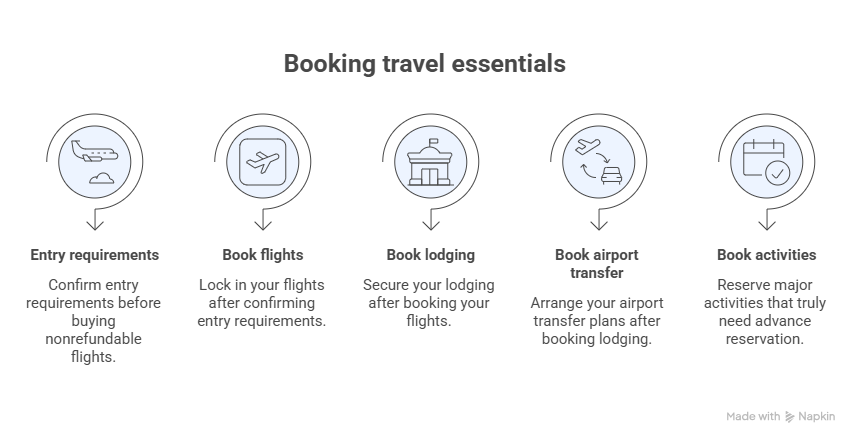
There is a rhythm to booking international travel that saves both money and confusion. Usually, you want to confirm entry requirements before buying nonrefundable flights. After that, lock in your flights, then lodging, then airport transfer plans, then major activities that truly need advance reservation.
Avoid overbooking your days too early. A full spreadsheet can look impressive, but it often leaves no room for weather, jet lag, neighborhood discoveries, or simple travel fatigue. The best itineraries have structure with breathing room.
Arrival planning is part of the trip
Many travelers focus heavily on the destination and barely plan the first six hours after landing. That is a mistake. Know how you are getting from the airport to your accommodation, what payment method will work on arrival, and how you will communicate if there is a delay.
If you arrive late at night, this matters even more. A destination can feel far more welcoming when the first move is clear.
Prepare your money and phone before departure
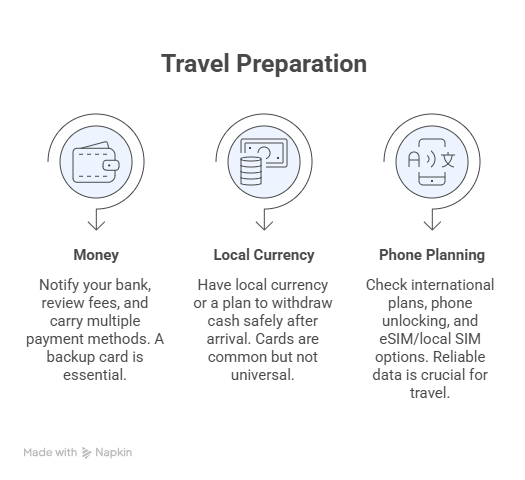
Using your finances abroad should feel boring. If it feels dramatic, something was missed. Notify your bank if needed, review foreign transaction fees, and carry at least two payment methods stored separately. A backup card can save a trip when one account gets flagged or a card reader fails.
You should also have a small amount of local currency or a plan to withdraw cash safely after arrival. In many destinations, cards are common but not universal. Taxis, local markets, or smaller businesses may still prefer cash.
Phone planning is just as important. Check whether your carrier offers an international plan, whether your phone is unlocked, and whether an eSIM or local SIM would be cheaper. Reliable data helps with maps, translation, rides, banking verification, and day-one orientation. It is not a luxury anymore. It is part of basic travel function.
Pack for mobility, not just outfit options
Packing is where travelers often add stress in the name of preparedness. The goal is not to bring everything that might be useful. The goal is to move easily while still being ready for your actual activities and climate.
Start with the trip structure. A city-hopping itinerary needs a different bag strategy than a week in one place. If you will be navigating train stations, stairs, ferries, or older neighborhoods with uneven streets, lighter luggage makes a noticeable difference.
Your core packing categories are straightforward: documents, clothing for the weather and local norms, medications, chargers and adapters, toiletries, and a few comfort items for the flight. Beyond that, be selective. Most travelers regret overpacking more than underpacking.
A few items earn their space every time
There are some practical items that consistently help on international trips: a universal adapter, portable charger, refillable water bottle where appropriate, basic medicine kit, and one change of clothes in your carry-on. If your checked bag gets delayed, that small decision feels brilliant.
Learn the basics of daily life abroad
This is the part many checklists skip, but it often shapes the trip more than any attraction. Learn basic etiquette, common greetings, local payment habits, transit expectations, and neighborhood safety patterns. You do not need to become an expert overnight. You just need enough context to move through the destination respectfully and confidently.
A few destination-specific phrases can go a long way. So can understanding whether restaurants expect reservations, whether shops close mid-day, or whether public transit runs differently on weekends. These details help you travel with less friction and more awareness.
For travelers who may one day live abroad, this step is especially valuable. The more you notice daily rhythms instead of just landmarks, the more useful your trip becomes. That is where brands like Global Footprints Abroad can offer real value - not just where to go, but how a place functions beyond the postcard version.
Reconfirm everything 72 hours before departure
A strong checklist ends with a final review. Check in for your flight if available, confirm passport and wallet access, verify baggage rules, review airport transfer details, download maps and key reservations, and make sure your phone can access essential accounts.
This final check should feel calm, not frantic. If it feels chaotic, the issue is usually not the trip. It is that too many decisions were saved for the end.
International travel will never be completely predictable, and that is part of the appeal. But the right preparation gives you room to enjoy the unfamiliar without being derailed by the avoidable. Plan smarter, leave some space for surprise, and let the trip become bigger than the logistics.