My friends Henry and Ashleigh have had a second home in Spain for a while now. Four years, give or take. They told me this story because they know I went through the whole moving abroad process myself a few years back, and I am passing it on so that you do not make the same mistake they did.
Because for basically all of those four years, they were walking around under a false impression.
When they bought the house, the gestor sorted out their NIEs for them. They arrived as pieces of paper with numbers on them, there was a stamp, somebody signed something, and they said it felt like a milestone. Like they had been let into the system. Ashleigh remembers taking a photo of hers and sending it to her mom.
And from that point on, whenever anyone asked, they would say something vague like "yeah, we're registered over there." Not a resident. They were never claiming that. But registered. On file. Known to the authorities in some general way.
They were not. At all. In any way.
The Bit Where They Found Out
This came up because they started talking about spending proper time there, more like half the year rather than a few weeks at a time, and they went in to ask about a couple of things at the town hall or ayuntamiento. Very confident. Folder under the arm.
The woman asked if they were empadronados. Henry said they had their NIEs, and slid them across.
She slid them straight back and said, and I am translating loosely here, "that is a number, it is not a registration."
They did the thing where you nod slowly as if you already knew. They did not already know.
What They Had Actually Been Carrying Around
The NIE is a Número de Identidad de Extranjero. It is your personal identification number as a foreigner. You need it for property purchases, for certain contracts, for banking, for tax. Which is exactly why they had one, because they bought a house.
Here is the part that reframed everything for them. An NIE can be issued to somebody who does not live in Spain at all. Somebody who just has economic, professional, or social interests there. That was Henry and Ashleigh, described precisely. The number was never a statement about where they lived. It was a reference attached to a person doing things in Spain, and they had quietly promoted it in their heads into something much bigger.
The Three Other Words Nobody Explained
Empadronamiento is registering with your local Ayuntamiento, the town hall, in the municipality where you actually live. In plain terms it says: this person lives at this address, in this town. It comes up constantly as a prerequisite for other local paperwork, which is how most people discover it exists. Usually while queueing for something else.
It is also not the same as residencia. It is your town's own record.
Residencia is the one everybody says and almost nobody says correctly. If you are an EU citizen, you generally do not need a traditional residence permit. But if you live in Spain more than three months, you must register in the Registro Central de Extranjeros, the central register of foreign nationals. What you get is the Certificado de Registro de Ciudadano de la Unión Europea, which lists your name, nationality, address, NIE, and the registration date. It is a green piece of paper. Not a card. Everyone, officials included, just calls it "la residencia."
Swiss citizens go through their own registration under the relevant agreement, so the word comes up for them too.
TIE is a different thing again. Tarjeta de Identidad de Extranjero, for non-EU citizens holding a Spanish residence permit. Americans, Brits, Canadians. It is a physical card documenting immigration status. Non-EU family members of an EU citizen may get a corresponding card in certain circumstances.
So when their British neighbor talks about his TIE appointment and their Dutch neighbor talks about her residencia, they are not being sloppy. They are genuinely in different systems.
The Short Version
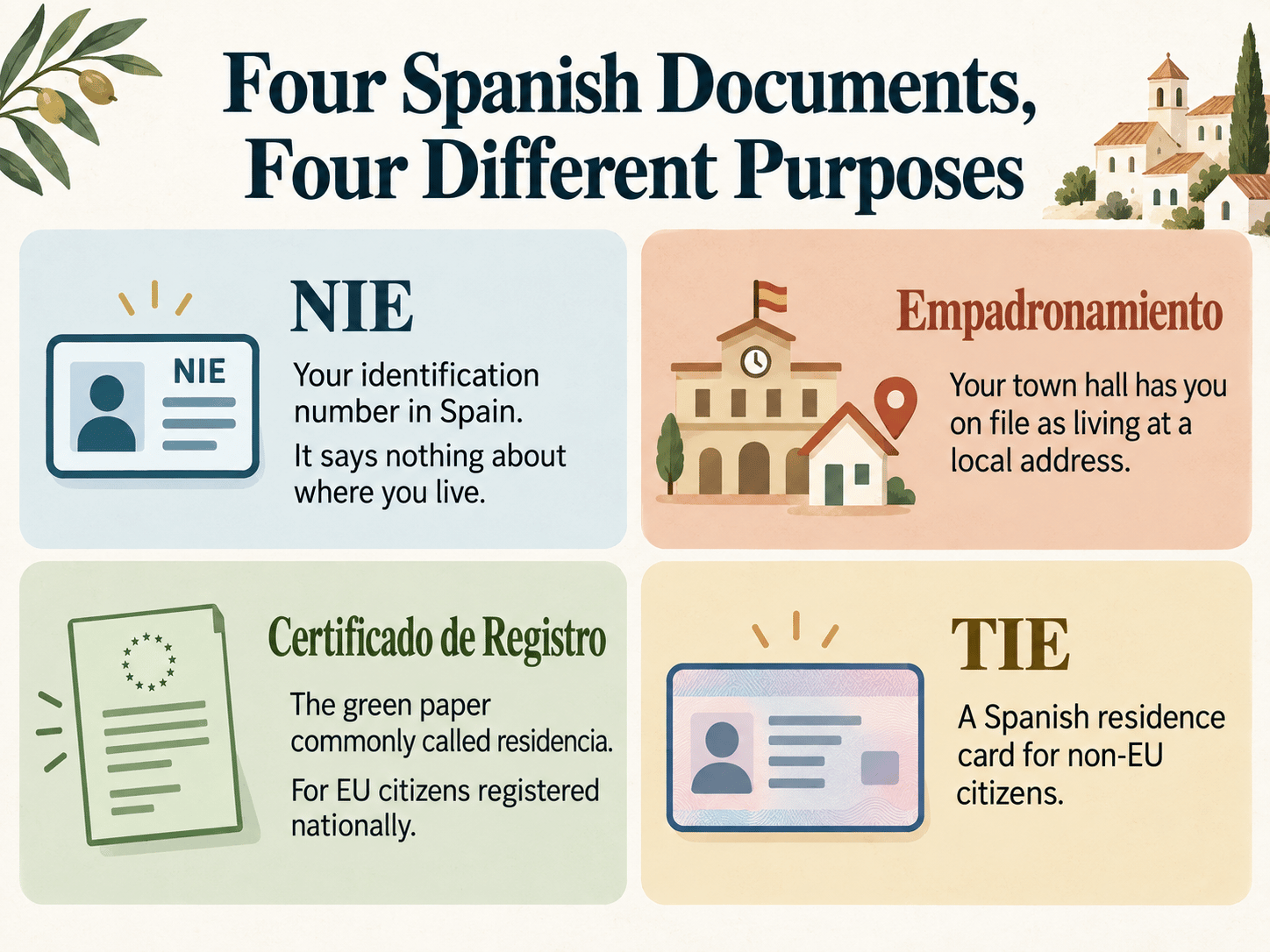
NIE is your number in Spain. It says nothing about where you live.
Empadronamiento is your town hall having you on file as living there.
Certificado de Registro, the green paper everyone calls residencia, is an EU citizen being registered nationally.
TIE is a non-EU citizen with a Spanish residence card.
Four things. Four different purposes. Used interchangeably in every conversation you will ever have about paperwork over a glass of wine.
What They Took Away From It
The way Ashleigh puts it now is that they spent four years quietly planning around a word they had never actually checked. It cost them a wasted morning and a second trip back, which in the scheme of things is nothing. What bothers them is how close they came to making a much bigger decision on the back of the same assumption. They were weeks away from committing to half a year there, still convinced the paperwork was handled.
Henry's version is shorter. He says he had a number, thought he had a status, and nobody in four years had any reason to tell him otherwise.
Before You Make the Same Assumption
If you want to find out whether moving abroad is possible for you, start by putting the numbers on paper. When I was working through my own move, I kept rebuilding the same spreadsheets and losing track of which documents I still needed, so I created the Moving Abroad Planner to keep it all in one place. The interactive PDF walks you through your decisions, documents, and next steps. The spreadsheet handles the math, with dedicated tabs for comparing countries, planning your finances, converting currency, estimating relocation costs, and mapping your timeline.
Henry and Ashleigh got there in the end. They just got there the long way round, after four years of assuming a number was a status.