What Nobody Tells You About Moving to a Country Where You Don’t Speak the Language
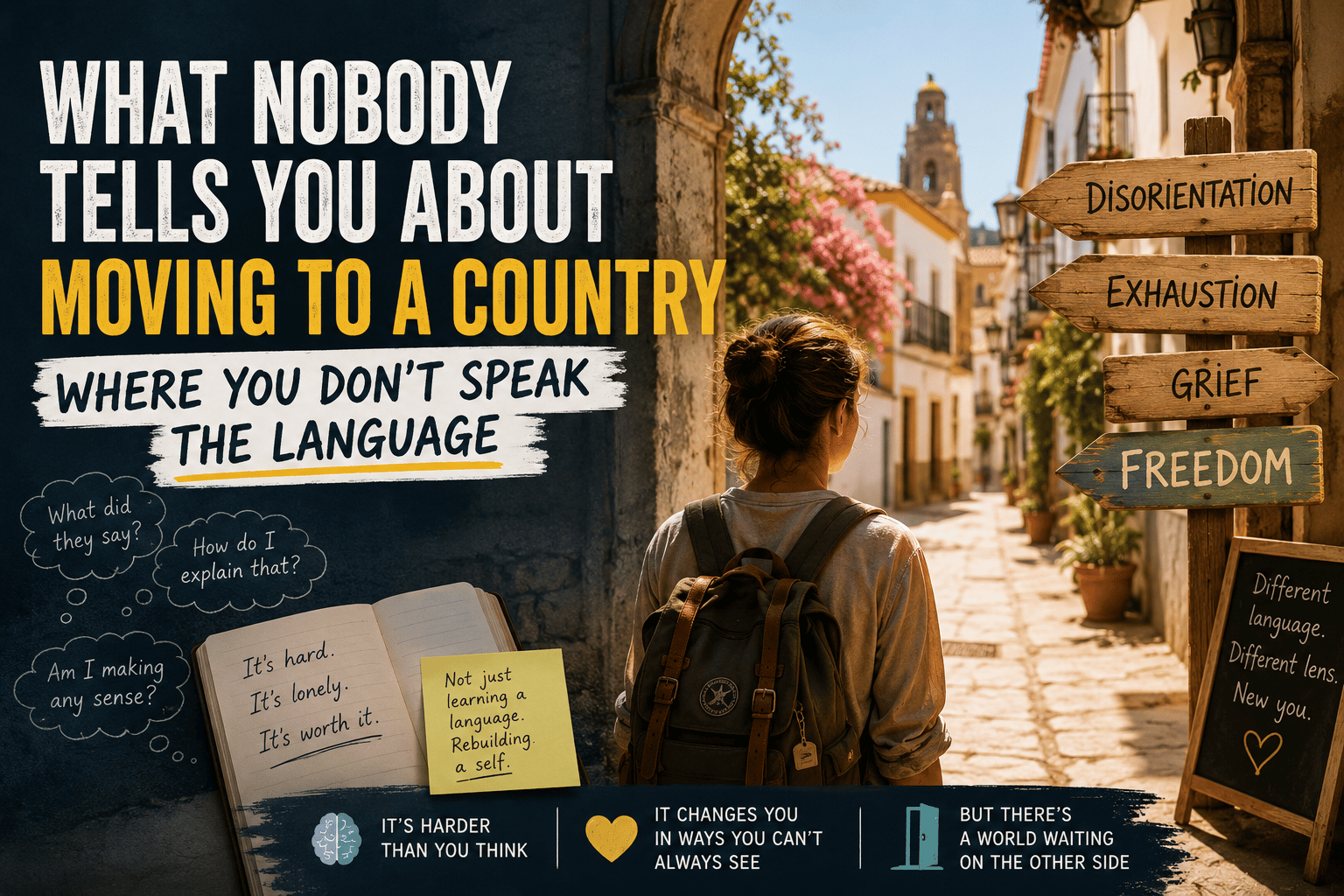
There’s moving abroad, and then there’s moving abroad in a language that isn’t yours.
The two experiences are not the same. Not even close.
When you relocate to a country that shares your language, the adjustment is real: the bureaucracy, the culture, the homesickness. But you still get to be you. You can charm the landlord, crack a joke, advocate for yourself at the doctor’s office, push back when someone gets it wrong. Your personality travels with you.
When you move somewhere with a completely different language, you lose that. And nobody really prepares you for what that costs.
It Feels Like Building a Life Underwater
The best way I’ve heard someone describe it: everything moves slowly. You hear words, you reach for their meaning, you assemble a response, and by the time you’ve done all of that, the moment has already floated past. The conversation has moved on. The window has closed.
You start to feel like you’re always one beat behind your own life.
It’s exhausting in a way that’s hard to explain to someone who hasn’t felt it. Not just tiring but depleting. Every interaction that would be automatic in your native language becomes an act of will. Ordering coffee. Reading a letter from your bank. Making small talk with a neighbor. None of it is passive anymore. All of it costs something.
The Shame Is Real (And Underestimated)
What surprises most people, and surprised me, is how much shame comes with the process of learning.
There is an acute embarrassment in sounding less intelligent than you are. In your native language, you can be funny, precise, layered. You know how to read a room and land a point. In a second language, especially in the early stages, you speak like a child. People wait patiently (or impatiently) while you search for words you own in two languages but can’t locate in the new one.
You know what you mean. You just can’t get there yet.
That gap between who you are and who you appear to be is quietly bruising. And it’s something people who haven’t experienced it tend to dramatically underestimate. Language learning looks like a skill from the outside. From the inside, it feels like a daily confrontation with your own inadequacy.
There Is a Grief in It
Something that doesn’t get talked about enough: you don’t just lose vocabulary when you lose access to your native language everyday. You lose a version of yourself.
Your humor. Your nuance. The way you can make someone feel understood in exactly the right words. The instinctive you, the one who doesn’t have to think before speaking, goes quiet. Things that once felt effortless now require conscious effort, and that shift is its own kind of loss.
It’s a grief. A real one. The kind that doesn’t have a funeral and doesn’t get acknowledged at dinner parties, but sits with you nonetheless.
If you’re preparing for a move like this, it helps to name it rather than push through it. You’re not just learning vocabulary and grammar. You’re mourning yourself, at least temporarily.
But There’s a Freedom in It Too
Here’s what I didn’t expect: as the language started to open up, something else did too.
Another language isn’t just a different code for the same thoughts. It’s a different way of seeing. Different things have names. Different ideas sit naturally inside syntax. You start to notice that you think slightly differently when you’re operating in your new language, that some things are easier to express, and some things you would have said in English feel slightly overwritten.
What once felt like a wall between you and your life starts to feel like a doorway.
And the self you build in that second language? It’s not a lesser version of you. It’s an extension. Someone who has learned to exist differently in the world. That’s not a small thing.
If You’re About to Do This
Go. But go knowing what you’re actually signing up for.
You’re not just signing up to learn a language. You’re signing up to be a beginner for a while. To feel slow when you’re smart, quiet when you have things to say, smaller than you are, and to keep showing up anyway. To grieve a version of yourself that you didn’t know you’d miss until it wasn’t available to you everyday.
That’s the part that guides leave out.
But here’s the other part: you will come out of this as someone who has lived in two worlds and can move between them. Someone who knows, in their bones, that identity is more flexible than it feels. That you can lose yourself and find a larger one. That a language isn’t just a tool but a lens, and every new lens changes what you’re able to see.
The destination is real. The is exhaustion is real. The grief is real. And so is everything waiting on the other side of it.
It will reshape you. Let it.