6 Best Regions for First International Trip
Affiliate Disclosure: This post contains affiliate links. If you buy through them, we may earn a commission at no extra cost to you.
If you are staring at a map wondering where your passport should take you first, the answer is usually not one country. It is a region. The best regions for first international trip planning are the ones that lower stress; easier flights, manageable culture shock, reliable infrastructure, and enough variety to make the journey feel bigger than a single stop.
This matters because a first trip abroad is rarely just a vacation decision. For many travelers, it is a confidence-building test run for future long-haul travel, remote work, or even the possibility of living overseas. The right region can make international travel feel exciting instead of overwhelming.
What makes a region beginner-friendly?
A great first region is not necessarily the cheapest or most famous. It is the one that matches your comfort level while increasing your worldview.
For most US travelers, the sweet spot usually includes straightforward entry requirements, decent transportation, clear tourist infrastructure, and destinations where you can recover quickly from small mistakes. Maybe you miss a train, arrive late, or realize your phone plan does not work the you thought it would. In a beginner-friendly region, those problems stay annoying instead of becoming trip defining.
Language also matters, but not always in the way people assume. You do not need to speak the local language fluently. What helps more is destination where signs, booking systems, and tourism services are relatively accessible. Cost, safety, walkability, and healthcare quality also shape how comfortable your first trip feels.
1. Western Europe
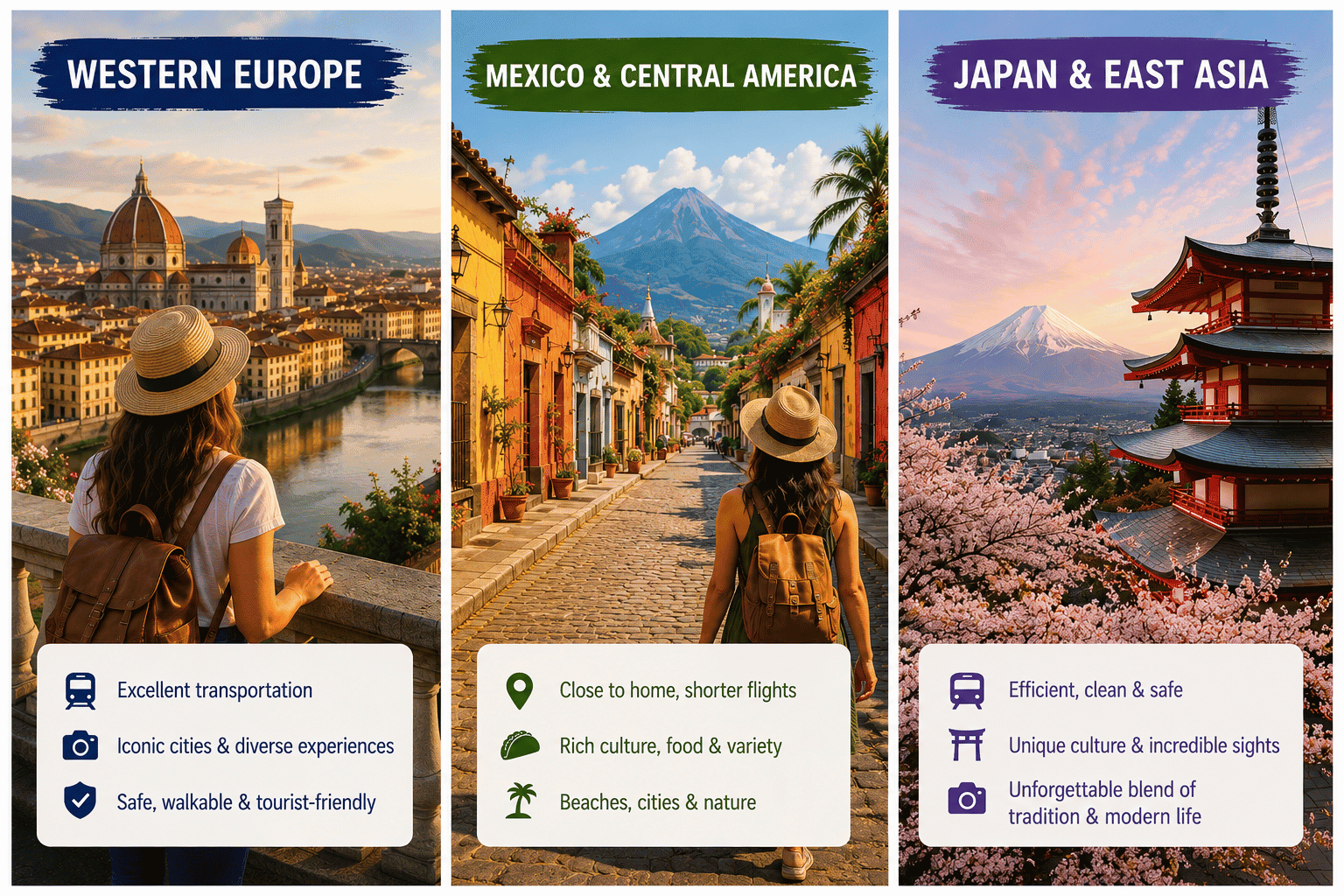
If you want the easiest answer to the best regions for first international trip decisions, Western Europe is usually it. Countries like Spain, Portugal, France, the Netherlands, Germany, and Italy give first-time travelers a high-functioning travel environment with strong rail networks, accommodation, and enough tourist familiarity to reduce your stress.
Western Europe works especially well if you want to visit more than one country on a single trip. Border crossings are often simple, transportation is efficient, and the learning curve is more manageable. Even when prices are high, the trade-off is convenience. You are paying for ease.
That said, not every part of Western Europe feels equally beginner-friendly. Paris and Rome can be magical, but they can also feel crowded, expensive, and fast-moving for a first international experience. Cities like Lisbon, Amsterdam, Madrid, or Munich often feel a bit more manageable. These cities still deliver culture, architecture, amazing food, and history, but feel less chaotic.
For future-minded travelers, Western Europe also gives you a glimpse of what living abroad can look like in a well-connected urban setting. You can observe public transit culture, neighborhood design, and the pace of everyday life, not just the landmarks.
2. Central Europe
Central Europe is often overlooked by first-time travelers who jump straight to the biggest names. This is a mistake. Cities such as Prague, Budapest, Vienna, and Krakow can be ideal first international stops because they combine beauty, strong infrastructure, and generally better value than Western Europe.
This region is a smart choice if your budget matters but you still want a polished, accessible experience. Accommodations, dining, and transportation can stretch your money further, which creates more room for spontaneity. You can say yes to a museum, a day trip, or a nicer hotel without blowing up your plan.
The trade-off is that some travelers may find the region slightly less intuitive than Western Europe if they are nervous about language barriers or unfamiliar transit systems. In practice, though, major cities here are used to international visitors. If you are comfortable doing a little planning in advance, Central Europe offers a lot of reward for relatively low stress.
3. Mexico and Central America
Not every first trip abroad needs to involve crossing the ocean. For US travelers, Mexico and parts of Central America offer one of the best entry points into international travel because they feel distinctly international while remaining geographically close.
Mexico stands out in particular. Shorter flights, a wide range of budgets, rich food culture, and a well-developed tourism network make it a strong first pick. Depending on where you go, you can choose beaches, city energy, colonial charm, or deeper cultural immersion.
Central America also works well, especially Costa Rica and Panama for travelers who want a smoother planning experience. Costa Rica is friendly for nature lovers and first-time international travelers who want eco-tourism, and a relatively easy landing.
The key here is destination selection. This region varies widely by city and country. Some places are incredibly easy for beginners, while other countries require more street smarts, stronger Spanish skills, or tighter logistics. If you want close-to-home convenience with real cultural depth, this region is a strong contender.
4. The Caribbean
The Caribbean is sometimes dismissed as too resort-focused, but that depends entirely on how you travel. For a first-time international traveler, the Caribbean can be a smart choice because it offers short flight times, less severe jet lag, and plenty of destinations where tourism infrastructure is already designed to help visitors arrive easily.
If your goal is build international confidence without taking on a complicated itinerary, this region makes sense. Islands like Aruba, Curacao, Barbados, and the Dominican Republic can offer a relatively easy first experience, especially if you want a blend of relaxation and light exploration.
The downside is that island travel can be less flexible than mainland travel. Inter-island hopping is not always cheap or convenient, and some destinations can feel expensive once you get beyond the flight deals. If you want museums, train rides, and city-hopping, Europe will probably fit better. If you want your first trip abroad to feel restorative and simple, the Caribbean might be exactly what you are looking for.
5. Japan and East Asia
If you are willing to go farther for your first trip, Japan is one of the strongest choices in East Asia. It is orderly, safe, visually striking, and deeply different from the US in ways that feel invigorating rather than disorienting for many travelers.
Japan works well for detail-oriented planners. Trains are efficient, cities are clean, and the tourism infrastructure is excellent. Tokyo, Kyoto, and Osaka form a classic first itinerary because the balance modern energy, tradition, and accessibility. For many people, Japan becomes the trip that changes how they think about urban life, public space, and everyday convenience.
The trade-off is cost and distance. Flights can be expensive, and the long travel times makes this a bigger commitment than Mexico or Europe. There is also a cultural learning curve, even if the country is easy to navigate in practical terms. If you thrive on structure and novelty, Japan can be an extraordinary first international trip. If you want maximum ease for minimum planning, it may be better as a trip number two.
6. Southeast Asia
Southeast Asia often shows up on budget travel lists, and for good reason. Thailand, Vietnam, Cambodia, and Malaysia, can offer incredible value, memorable food, and a strong backpacker trail. For some travelers, it is absolutely one of the best regions for first international trip experiences.
But this is where honesty matters, Southeast Asia is beginner-friendly for some people and overwhelming for others. If you’re adaptable, curious, and open to sensory overload, it can be a brilliant first region. Thailand in particular is often a good starting point because it welcomes tourists and has a well-worn path for independent travelers.
Still, the long flight, climate adjustment, and culture shift are real factors. This region rewards flexibility more than control. If that excites you, it may be the perfect launch point. If not, you may enjoy it more after building your confidence elsewhere first.
How to choose the best region for your first international trip
The right answer depends less on what is objectively best and more on what feels realistically doable for you right now. If you want low stress and classic highlights, Western or Central Europe is hard to beat. If you want proximity and cultural richness, Mexico is a standout. If you want rest with a passport stamp, the Caribbean fits. If you want a bold but organized leap, Japan is an excellent choice. If budget and adventure are your top priorities, parts of Southeast Asia deserve a serious look.
A good first trip should expand your world without making you feel like you are constantly recovering from your travel. That balance matters. The best region is the one that leaves you thinking, I can do this again.
At Global Footprints Abroad, we believe the first international trip is less about checking off a famous destination and more about starting a longer relationship with the world. Choose the region that gives you moments and perspective.
Your first passport stamp does not need to be the boldest choice on the map. It just needs to be the one that gets you out the door with your curiosity intact and builds your confidence.
Affiliate Disclosure: Some of the links on this site are affiliate links. If you click on one and make a purchase, we may earn a commission at no additional cost to you. We only recommend products and services that we believe will be useful to our readers, and affiliate relationships never influence our opinions or the content we publish.